Saturday, March 27, 2010

Experiments in Narrative Film (and a baby birth)


Hello everyone! It has been a while since my last post and things have changed since we last talked. Things have gotten a little crazy and Maya Deren and Stan Brakhage have made a permanent imprint on retinas. Stan Brakhage seems to be more about the experimental-ness of the content, not just the technicality. Maya Deren explores the ways to use camera through a surreal setting.

"Meshes in the Afternoon" is an extremely interesting showcase of camera tricks and symbolism. While taken in context the image to the left makes some sense, it is really funny when coming across it on the internet. Personally, I have been getting semi-frustrated with all of the feminist media we are assigned in our classes. This collection however, made that subtext. Being an English major I look for the story.

"Meshes in the Afternoon" is very surreal. The film creates a smattering of different Maya Derens all repeating the same afternoon routine. There is a figure shrouded in black and has a mirror face. Yes, his face is a mirror. There is a lot of symbolism riddled throughout film. The key is cross cut with the knife, implanting the correlation between the two in our minds. So when we see her dead at the end of the film we assume that she killed herself in order to 'unlock' the way to her freedom. Sorry about the obviousness of that, but I feel it is an extremely important aspect of the film.

We find out quite literally that the shrouded figure is her companion. The ominous figure she is trying to escape from is not only her lover, which we see from her laying in the bed when he gets home, but is in fact the routine itself. What is really interesting is how previously we see Maya climbing the stairs. She is displaying the struggle in her subconscious of how she knows what is going on is oppressive and wrong. In her essay she talks about all of the camera tricks she uses in a very technical fashion and I think it is extremely interesting how she uses the camera to alter reality. In a great coordinative effort, Maya falls right and left with the camera as it shakes to the left and right. This gives the effect that the planet itself is being tossed around. As we get closer to the top Maya turns the camera sideways and upside down, she alters what we think is real with in an attempt to show us her knowledge of the camera.

"At Land" is great for considering the essay in which she talks about altering space and time. She starts at the beach which we can associate as the underworld as she only goes up from this point. In the middle world, or midgaurd as the Norse would call it, It is just a bunch of white men sitting at a table talking. Which is her metaphor for what our lives our like up here. She cuts the film stock so that it appears she climbs the tree trunk and immediately appears in this world. She alters space to explore what how film can manipulate reality.

A pawn falls down into the underworld and she goes after it. The pawn which by definition is meaningless and one of many, becomes men who interchange every time they are put in the shot. We also get this awkward situation where a woman in white and a woman in black are playing chess in the underworld, only two are doing it and that it feels like that is the only way they can get away with it. They do not seem to care taht they are playing chess which could mean that they are doing it and going through the motions just to spite men.

All in all I believe most of this collection is a feminist backdrop to great film tricks. I would talk about Brakhage, but I'm afraid to be fined by the FAA.

Saturday, March 6, 2010

James Bond's Worst Nightmare (In French)


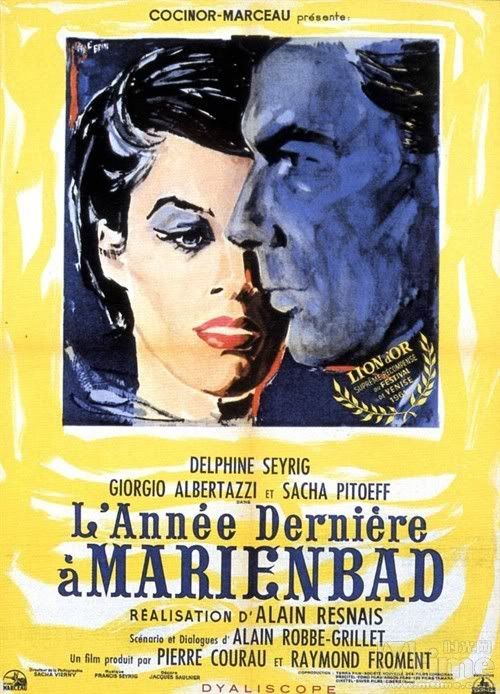
The Last Year at Marienbad is extremely hard to get through on your first viewing if:
a. You do not know anything about French New Wave
b. You are already sleepy.

This being my first viewing of the a fore mentioned movie I had some problems. The cyclical filming and dialogue caused my eyes to close two or three times. The French voice mixed with the repeating dialogue will lull you into a coma. The beginning of the movie is a series of shots looking up at chandeliers at other things you would see on the ceiling of a castle or mansion. It is overlapped with a poem that is repeated and it is almost calling you to go to sleep, to begin dreaming yourself.

Also, the narrative in the story is f*****. I got a better hold on the story when talking about it in class. Watching it in class made my brain hurt trying to follow it. Professor McRae told us not to pay attention to the story and just pay attention to the camera tricks and the techniques used by the film makers. I couldn't do it. While the cinematic style pulls you into a almost dreamlike state, the story doesn't let you go either. A love triangle between the characters the script calls X, the narrator, A the woman and subject of men's desires, and M, possibly A's husband, is gone over and shown through various situations throughout the film.

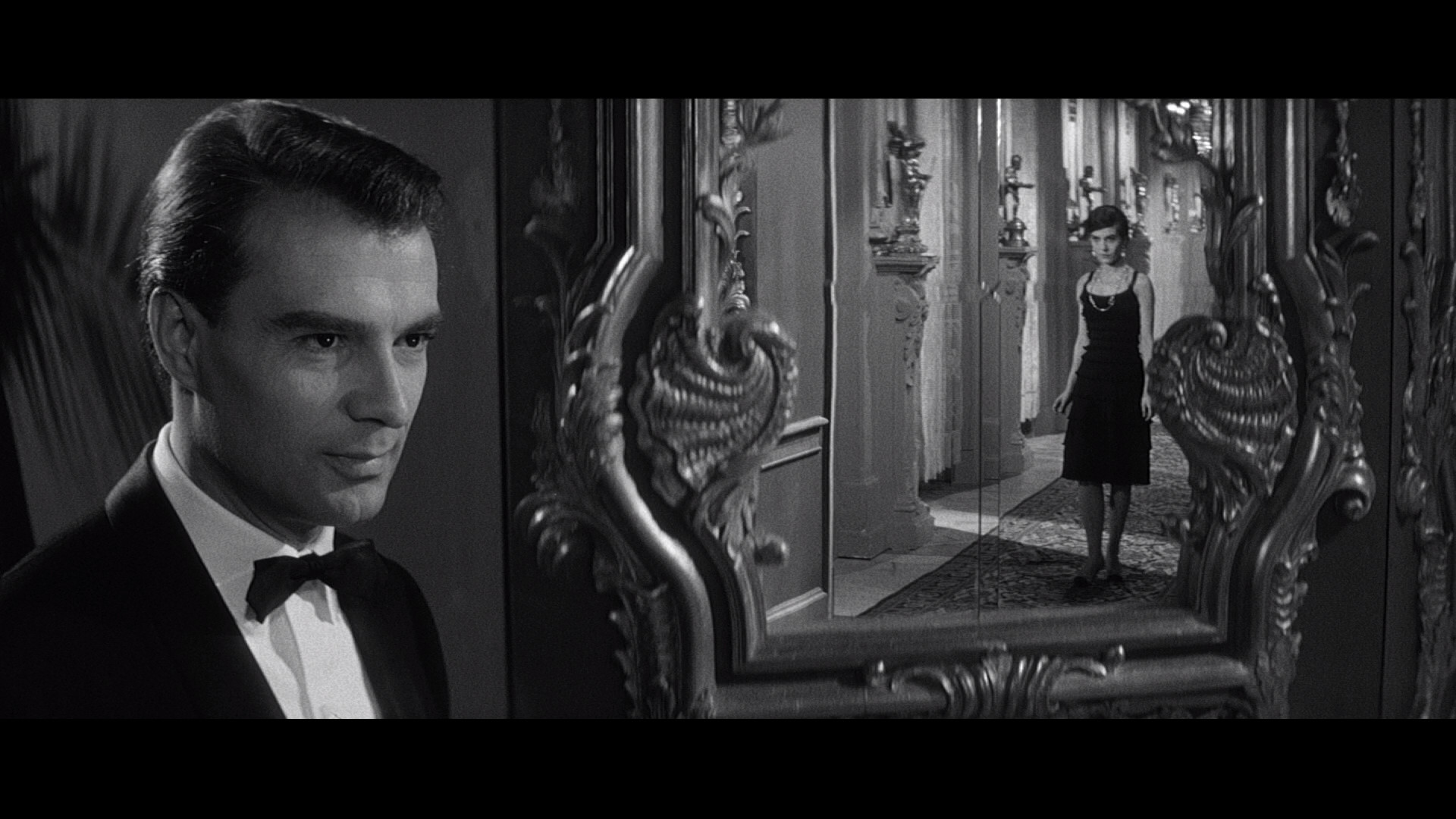
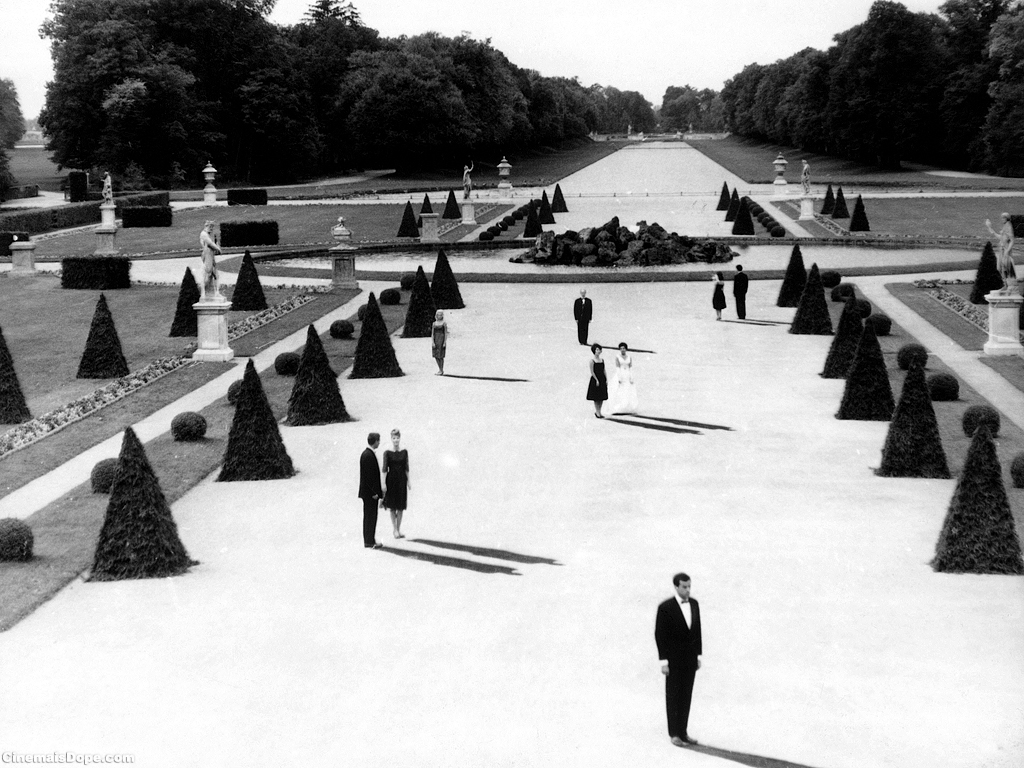
The movie revolves around X's attempt to pick up A. X being the creepy guy in the image to the right, and A being the woman in the man's crosshairs. The way I interpret the narrative in the film is by trying to establish a linear series of events. The movie takes place at a mansion and the events X is talking about happened one year before that day. The one scene that does not change is the scene where X and A are out in the courtyard against the base of a statue. X is feelin' all up on A and while she seems into it for like three seconds, she tells him to leave her alone. After this, all events are subject to change and we get multiple versions of the same events.

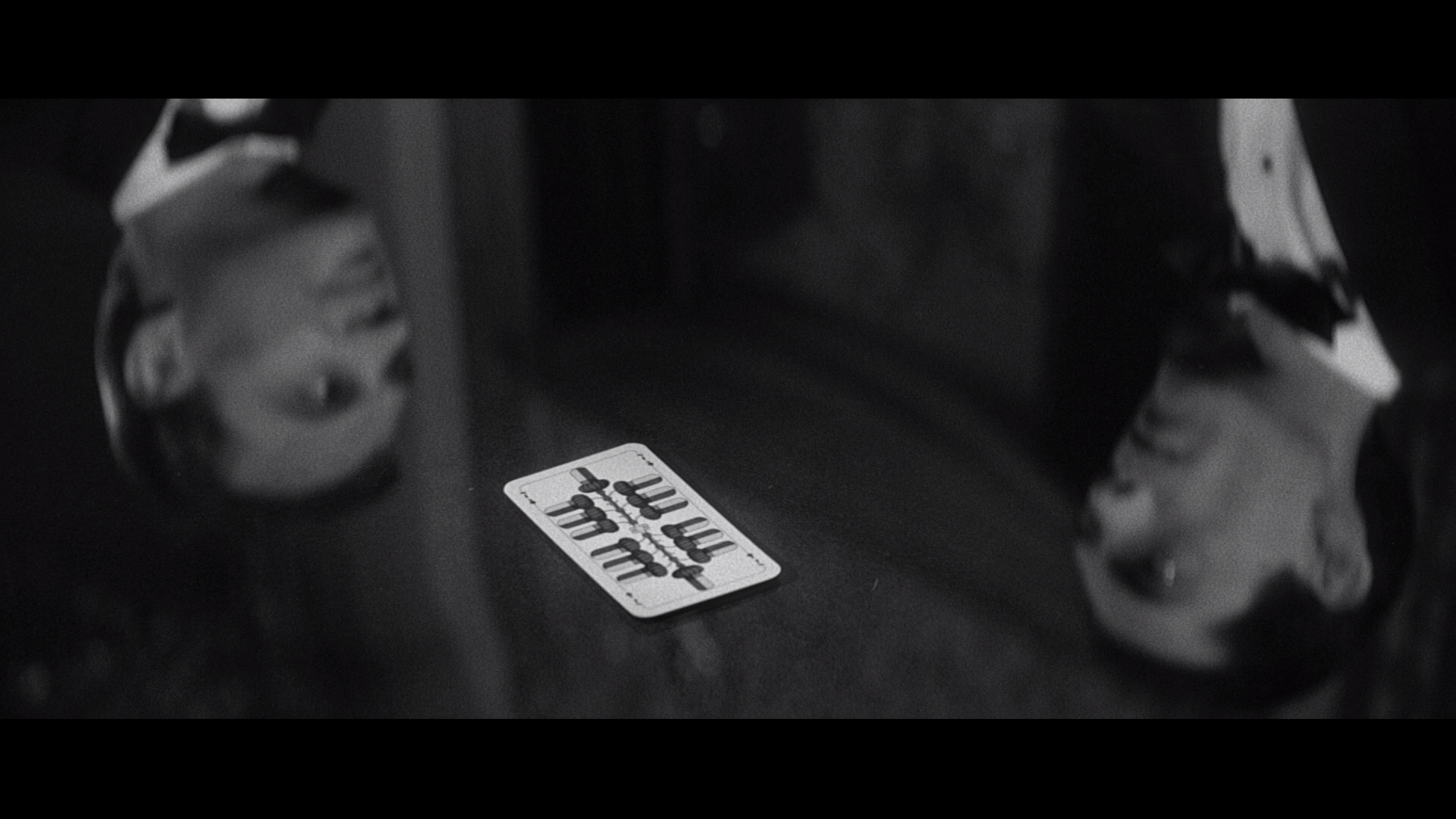
Much like the odd shots of peoples images reflecting off of mirrors and shiny objects, we get an obscure view of everything that happens after the event at the statue. What makes logical sense to me in this movie is that X is traumatized by being shot down by A and after wards cannot escape a series of what if situations in his dreams. He keeps creating and recreating events in his dream so that he gets the girl. He is stuck in the mansion, which we get a feeling of through the repetitive dialogue, and can only escape his nightmare with the woman that he is seeking. Because this is a dream A also becomes subject to X's will and ends up leaving with him.

This feels like James Bond's worst nightmare to me because;
1. He is British and therefore hates French.
2. Is stuck in a French Mansion.
3. Does not get the girl.
Everyone in the film is really well dressed and look like they were pulled straight from a Bond film. We also get a feel for this series of what if situations that the bond character creates because he is shot down by the girl is the formality of their speech. In class we talked about listening to the French dialogue and how they always talk to each other in an extremely formal fashion which could hint to their never getting past the initial hook up phase.

The article on how this movie relates to Descartes was really an interesting read. The courtyard above is apparently a product of Cartesian thought. The symmetry and angular shapes go to the thought that the mind, being a non-physical entity, sees nature as raw material for people to superimpose their ideas on nature. The gardens would be construct into angular shapes that are anything but what would appear in nature. Which is also interesting considering how often this picture shows up in the film. It is almost as if the director is trying to tell the viewer that everything there in the film is subject to X's mind, and is not what actually happened.

Saturday, February 20, 2010

Vertigo by Any Other Name, Would Still Be a Really Creepy Image of Jimmy Stewart


So, having proclaimed the title of my little rant to be, I would first like to point out how f****** creepy Jimmy Stewart can be. By the end of the movie we know what his intentions were/are, but we still feel that almost violent nostalgia as we progress through the second half of the movie. Jimmy Stewart, too me, is such a staple of the family movie genre that this movie was borderline horrific to watch.

In Vertigo we get this same kind of irrational draw to the image of the ideal woman as in Preminger's Laura. In both we have this painting that kind of haunts the Mis en scene in both films.
While the one in Laura is an absolutely gorgeous depiction, that I might someday hunt down without explaining to my future wife why, that causes the main character to fall in love with her. In Vertigo there is this creepy 100 year old painting of a dead woman that Scottie's character becomes obsessed with. It also becomes a bit of fun for a friend. Instead of being a picture of Madeline we have a picture of Carlotta, which kind of plays to the deceit that Scottie is a victim to. We think it is Carlotta in Madeline's head, which Scottie believes he's fallen in love with. But in actuality it is Judy who is pretending to be Madeline which Scottie falls in love with. In either case it is Madeline that Scottie falls in love with, but the deception of who the lie that is Madeline, is symbolized through Madeline's absence in the portrait.

Oh, haha, I almost completely forgot this weird love triangle, consisting of two actual people, movie masquerades as a detective film for the first half of the film. Scottie is contracted as a private investigator to follow Madeline, which kind of foreshadows the rest of the film because a P.I.'s job is to be obsessed.

The plot leads us to believe that there is a suicidal spirit controlling Madeline. This drives the first half of the plot. As we get into the second half of the movie we see a woman who looks remarkably similar to Madeline, except she has bad makeup, bad hair, and this mid-west drawl to her voice.Turns out she (Judy) was pretending to be Madeline so that Elster could kill his wife (Madeline) and have Scottie as a witness to her lunacy. Scottie tries with an almost fierce sense of utter delusion to recreate Madeline from Judy. The love is actually between the two the whole time, which is were we get into symmetry. In class we talked about how the movie was forced symmetrically. Scottie is tryin to recreate his exact visions of her which we get in sort of a loop. We start back at the beginning of Scottie's experience with Madeline and how how he is going out to recreate that, to recreate his image of beauty. This again goes back to Laura and how the main character becomes obsessed with an image of a woman instead of the woman herself.


We also discussed in class, the point of view of the movie. Besides for the one scene where Judy has a flashback to reveal what really happened, which feels really forced in my opinion, the entire movie is from Scottie's POV. This gets us into the Freudian discussion brought up by the reading. Since the POV is the main character's, sometimes literally. We identify with him, no matter which gender (ego libido) and we see Madeline as the sexual attraction the whole movie. What is crazy is that everyone who watches this movie experiences this. So when we get this scene of a Madeline slightly recreated we all cringe because she is not what Hitchcock has built up beauty to be like.

Saturday, February 13, 2010


Otto Preminger’s Laura definitely deserves to be remembered. The cinematography follows in the footsteps of Citizen Kane in how it portrays the main character through camera tricks and storytelling.

(SPOILER ALERT) Lydecker did it. Ok? At the point in the movie where we find out about this, you do not even care really. Lydecker becomes irrelevant. However there are some huge hints throughout the movie that range from obvious too subtle. The obvious hint is when McPhearson arrests Laura and Lydecker is excited that she is the one getting arrested, not him.

Other moments where Lydecker’s guilt is foreshadowed are subtler. Lydecker owns a pair of unique clocks and gave Laura one of them. When this was mentioned, Harry Potter and the Half-Blood Prince popped into my head. It seemed a lot like the vanishing cabinets kept in the room of requirement, in Hogwarts, and the other was in Borgan and Burkes, which was in Knockturn Alley, the shopping center for dark wizards. The cabinets were used to send items that would be used to kill Dumbledore. Which is ironic because that clock is where Lydecker hid the shotgun he used to kill the model Vincent Price’s character was bangin’ at Laura’s place thinking it was Laura.


Other things that were noticeable in the way the movie was shot was that at certain moments in the film, Lydecker cast a very strong shadow, hinting to his ill intentions. Other characters of course had shadows, but were none were as eye grabbing as Lydecker’s. As he was leaving Laura’s apartment near the end of the movie his shadow was extremely dark. Also, McPhearson would only pull out that little baseball game, like he is trying to figure out Lydecker, to physically put the pieces in place, much like Kane’s second wife with the jigsaw puzzles.

Femme Fatal, the text we read for this movie sheds some light on the sexual symbolism of the characters in Laura. There is no Femme Fatal in the forefront movie, the title character is the epitome of the ideal woman. Her picture in the living room of her apartment is so enchanting you begin to fall in love with the softness of her character just from that picture. The picture has a kind of gravity to it that draws you in. It is the best prop in the movie.

The review of Laura also mentioned the spectrum covered by Lydecker, McPhearson, and Carpenter. Lydecker is high class, high society, and flaming. He appears to represent an extreme of Laura’s taste. Carpenter is a suave man who is skating by in life no his looks and his charm. Kind of like a free-loading Han Solo character. McPhearson is the man’s man, clever, and rugged. These three characters are three different kinds of men and Laura finds herself in the middle, even though she is dead.

In class we talked about the triangle formed in the scene when Laura returns home from the country . McPhearson is passed out on the chair from drinking and the shot has Laura’s portrait in the background to almost suggest what he is dreaming about. When she comes in and sees McPhearson sleeping the camera gives us Laura on the left, the Portrait between the two and above, and McPhearson to the right. It is as if the Portrait is a character itself that McPhearson has fallen in love with and now he has to distinguish between the two Lauras.

Sunday, January 31, 2010

Citizen Kane


Citizen Kane, which has been called the best film ever made, annoyed me. This movie was about the way in which it was filmed, not about a story. In some aspects there is a significant lack of a story. A collection of first hand accounts made the story feel like a cliche detective story, but it is in how this movie is filmed where the true genius of the movie lies.

Deep focus is when the foreground, midground, and background are all in focus. The whole movie is famously shot in this way. It makes you feel like you are getting the whole story,but actually you are only getting the story through an objective perspective. However; that person who is giving us the story objectively, only knows the story through subjective accounts by people who were, at one point at least, close to him. There is no real objective insight into Kane's life in this movie, and one is almost fooled into believing we are, just by the way the movie was shot.

Brilliant by any standard.

With that being said, by the time you reach the end of the film where we retreat back to the ominous shot that looks like the backdrop to the opening of an episode of Scooby Doo, we stumble upon a realization. We were not supposed to understand Kane.

One of the very notable shots that sticks in everyone's head from the opening and closing sequences is the shot of the NO TRESPASSING sign.

Reflecting on the significance of showing that at the beginning and the end of the film made me feel taunted by Orson Wells. The giant ominous mansion is the persona of Kane and the NO TRESPASSING sign is Wells telling you. Don't worry about figuring him out. You're not supposed to, just enjoy the ride.

And I think that is exactly it. Perception is what the movie was about, even what Kane was about. He finished Jed's review of his wife's performance badly just to keep his persona as an honest individual. When his wife was leaving him, it was about what the guests would think.

I also found the episode of the
Simpsons where they make fun of the movie. Best part of it is at the end of the episode where homer asks, "Is it a happy ending or a sad ending?" Marge replies, "It's an ending, that's enough." A perfect way to sum up the end of Citizen Kane.